
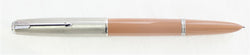


The Parker 75 fountain pen is a remarkable pen. In 1964 it was offered at $25, a staggering price tag for a pen produced for the 'mass market'. On paper it looked doomed, it was nothing like the Parker 51 or Parker Duofold, the most successful Parker pens so far, it was a cartridge/converter filler made from solid Silver, the ballpoint pen was ravaging the fountain pen industry, and the 75 was outrageously expensive. It was a huge success and sold over 10 million units over 30 years!
This pen is a very early Sterling Silver crosshatch Parker 75. The pen, launched on October 17th, 1964, featured a '0' reference mark on the ring around the section just before the nib. The first change to the pen was to remove this zero, it is present on this example. Other early changes included shortening the clip and lengthening the 'arrowhead' on the clip, this pen has the early version in both cases.
The length of the pen, when capped is 13cm. The cap is a push fit which posts securely in position for writing, although many users prefer not to post a metal bodied pen. The posted length is 14cm. There is a mark on the section as shown it does not affect the en in any way but should be mentioned. As the 'zero reference' sections are so rare I decided not to replace the section and maintain originality. The silver has a good, ding free surface and the gold filling is in excellent condition.
At each end of the pen is a Gold filled 'stack of coins' stud with the early flat top design, this was replaced by a dished stud around 1970 and the 'coin effect' is lost on the very late models.
Around the cap band the pen is engraved:
The Parker 75 is a cartridge/converter filler, a most convenient arrangement as it allows for the ease of use of cartridges with the flexibility offered by the use of bottled ink. The pen performs equally well with both filling systems and which one to use is merely a matter of personal choice. I favour using bottled ink, partly because I always have a range of inks to hand but I do enjoy the process of filling the pen and being able to easily flush it between changes in inks. The use of bottled ink is probably a good deal more environmentally sound and is certainly much, much cheaper than using cartridges. This pen is fitted with a modern converter and is supplied with an ink cartridge so it is ready to write in either configuration.
The pen is comfortable in the hand, it is a very tactile item with an unmistakable top quality 'feel' of solid Silver. The Parker 51 is often referred to as 'the best pen Parker ever made' but I think this is a questionable assertion when it is compared to the fabulous Parker 75